Trees
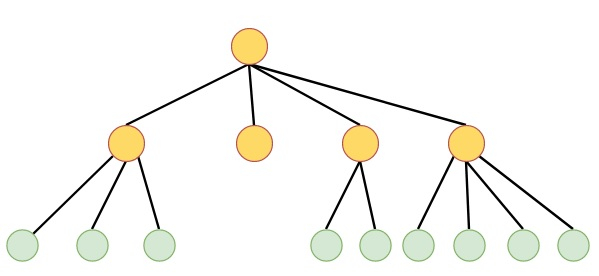
a collection of nodes, where each node is a data structure consisting of a value and a list of references to nodes. The start of the tree is the root node and the reference nodes are the children
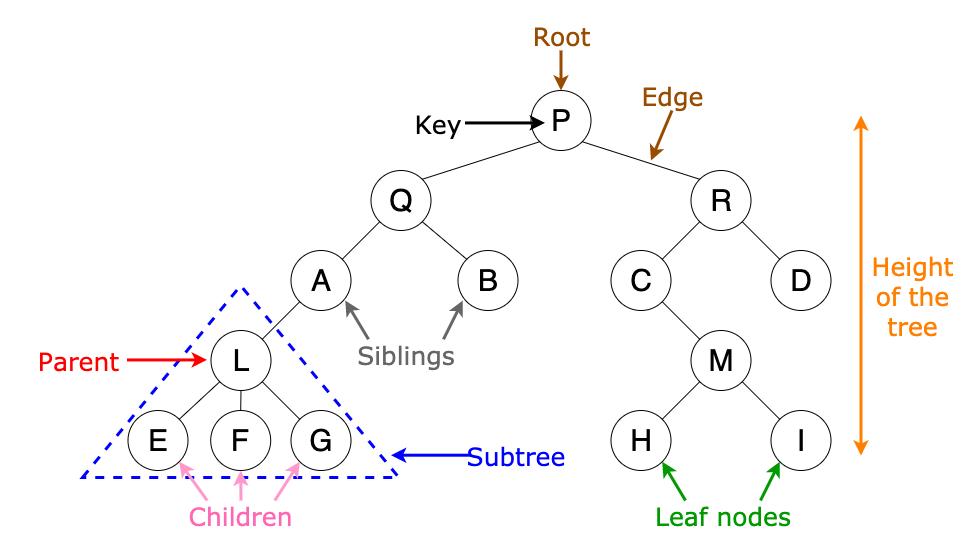
A Binary Tree
A binary tree has the benefits of both an ordered array and a linked list as search is as quick as in a sorted array and insertion or deletion operation are as fast as in linked list.
it contains following parts:
- Data
- Pointer to left child
- Pointer to right child
Tree terms :
- Node - A Tree node is a component which may contain it’s own values, and references to other nodes
- Root - The root is the node at the beginning of the tree
- K- A number that specifies the maximum number of children any node may have in a k-ary tree. In a binary tree, k = 2.
- Left - A reference to one child node, in a binary tree
- Right - A reference to the other child node, in a binary tree
- Edge - The edge in a tree is the link between a parent and child node
- Leaf - A leaf is a node that does not have any children
- Height - The height of a tree is the number of edges from the root to the furthest leaf
Traversal categories:
- Depth First : going through the depth (height) of the tree first and it is have three methods for depth first traversal:
- Pre-order:
root >> left >> right - In-order:
left >> root >> right - Post-order:
left >> right >> root
- Pre-order:
- Breadth First : iterates through the tree by going through each level of the tree node-by-node.
K-ary Trees
is a rooted tree in which each node has no more than m children